
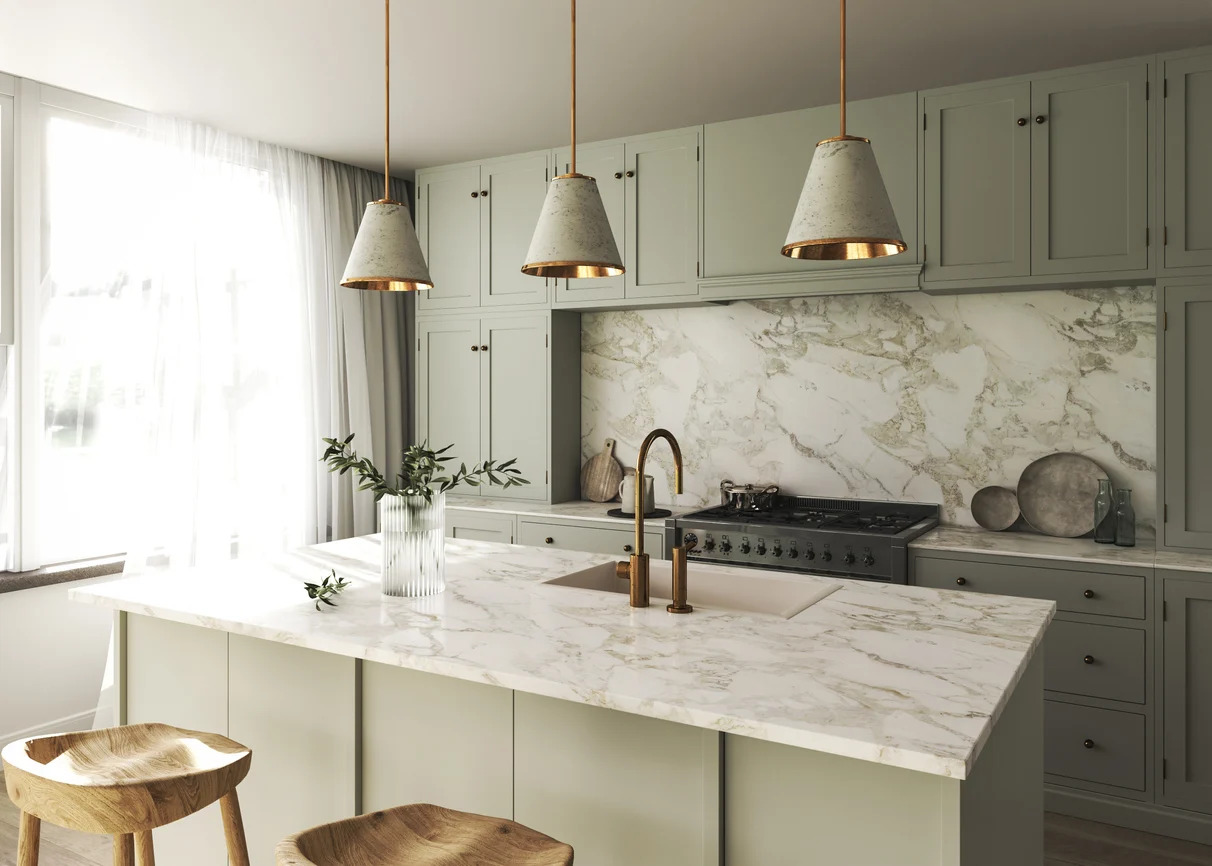
Anyone who has spent time picking out a kitchen countertop knows the shortlist usually comes down to the same few materials — granite, marble, and quartz. Each has its own character, but quartz has steadily become the material homeowners and architects in Kerala reach for when they want something that looks premium on day one and still looks premium five years later. We at Elegant Granites and Exports, the sole distributor in Kerala for the Haique collection of engineered surfaces, Quartz countertop suppliers in Kerala are frequently asked about quartz every week, with usually two questions that are close to one another: “Is it actually worth the price?” And “How much work is it to maintain?” Both are legitimate questions and both need honest answers rather than a sales message.
What Quartz Actually Is
Quartz countertops don’t come from a single piece stone, like granite or marble slabs are. They’re made — typically between 90 to 94% crushed natural quartz blended with resins and pigments then cured before being cut into slabs. This process of manufacturing is one of the reasons quartz has the greatest benefits over natural stones with regards to quality and consistency. Granite slabs are made of natural stone therefore, every slab is the same and every slab is awash with tiny pores. When it is engineered, Quartz creates a non-porous, smooth surface that is more uniform in the color and pattern. This is crucial when trying to match your kitchen island to the stretch of counter-tops that are affixed to the wall.
Why Homeowners Choose Quartz
It’s not stained in the same way that natural stone would. Since quartz isn’t porous and therefore, liquids stay on the surface rather than soak into. Coffee, turmeric red wine, cooking oil – all the things that can seriously damage the granite counter-top over time – can be wiped off the quartz surface without leaving a shadow in the event that you don’t let the spill remain for a long time. This single feature is the reason quartz has been the most popular option in busy Indian kitchens where oil and turmeric staining are a common rite of passage for every countertop.
- It’s truly healthy – The non-porous surface does not allow bacteria a place to hide. That’s more important than it seems when you think about how much food preparation raw occurs on kitchen counters. This is among the main reasons that Elegant Premium Quartz has been incorporated into hospitals reception desks as well as commercial kitchens, and not just houses.
- It can withstand temperatures – Quartz can withstand the warmth of cooking, hot vessels and hot tea cups without issue. But it’s not impervious to damage; the resin that holds the quartz together will begin to melt around 150 degrees Celsius and a pan that is positioned straight away from the fire with no trivet may cause harm. We advise our customers that quartz is heat-resistant but not heat-proof, and that is a major advantage that helps protect many countertops.
- It’s durable enough for an actual kitchen – With the quartz content and the binder made of resin the surfaces resist chipping and scratching much better than soft natural stones. You can cut, move pots about, and operate counters the way the kitchen should be used, without tinkering with it.
- It doesn’t need sealing – Granite and marble need periodic sealing to stay stain-resistant — miss that maintenance step and the stone starts absorbing everything. Quartz skips that requirement entirely, which is a real advantage for anyone who wants a beautiful counter without adding a recurring task to their calendar.
The consistency of the design is difficult to beat. Since quartz is engineered instead of quarried, companies like Haique can produce large seamless slabs of different colors and patterns which aren’t found in natural charcoal. They can also create white veined patterns like marble, however without the fragility. If you are planning an island in the kitchen or a long, continuous countertop run, this uniformity across slabs is an advantage in practical terms, and not just for visual reasons. Elegant Granites Delivering the Premium Quartz kitchen countertops in Kerala.
Maintaining Your Quartz Countertop
The great thing about quartz is that maintenance is simple and easy, however “low maintenance” doesn’t mean “no maintenance.” Certain habits can be a great way of maintaining the appearance of the quartz the same as it did on the installation day.
- Make sure to clean up spills as they occur : Quartz is resistant to staining, however it’s not immune particularly when it comes to highly colored substances such as turmeric and beetroot juice or ink. A quick wipe using a damp cloth is typically all you need.
- Use gentle dishwashing soap with warm water to do daily cleaning : There’s no need for special stone cleaners in this case. A sponge or cloth using dish soap works with the daily grime with ease. After cleaning, rinse the surface and dry it using a soft cloth in order to avoid water spots forming in time, especially in the area of the sink.
- Avoid harmful chemicals : Cleaners for ovens, bleach as well as anything with a high PH, or strong solvents may cause the resin to dull over time, and can affect the surface. If you’re faced with a smudge or scratch, a non-abrasive cleaner designed for engineered stone or a paste made of water and baking soda that has been left for a couple of minutes is a more secure alternative to using some industrial product.
- Use cutting boards and trivets : We’ve mentioned the threshold of 150degC earlier, but it’s worth repeating since it’s the primary reason for the damage we encounter. A hot pot or pan placed directly on the counter could cause the resin to burn. Quartz is also scratch-resistant but not scratch-proof therefore a cutting table will protect your knives as well as your counter.
- Use sealants and not polishes : Since Engineered Quartz in Kerala doesn’t require sealing, the use of polish or wax products specifically designed for natural stones could create an opacity or haze instead of increasing the shine. The finish applied at the facility is made to keep its shine in its own right following regular cleaning.
- Rinse and dry following cleaning : This little step can prevent mineral deposits caused by hard water forming the appearance of a dull film on the sinks and taps, particularly frequent in areas with a harder municipal water supply.
Based on these practices that a quartz countertop in the present can look fresh for a good decade. That’s the reason why homeowners tend to view this as a longer-term purchase than merely a finishing.
FAQ
1.Quartz is superior to granite kitchen countertops?
The foundation of the stone is important. It is an element of nature stone with a unique beauty, but it needs regular sealing and it’s porous. Quartz offers better patterns that are uniform and does not require sealing and a superior stain resistance which makes it a lower-maintenance option for the majority of houses.
2.Are hot pots able to be set directly on the countertop of a quartz?
It’s best not to. Quartz is able to handle everyday heat well, however the resin’s contents can be damaged by prolonged extreme heat, which is around 150 degrees Celsius. A trivet is a simple practice that helps protect the surface over time.
3.Do you think that quartz should be sealed the same way as marble or granite?
Yes. Quartz’s non-porous and engineered structure is one of the reasons it doesn’t require sealing. This is among the main advantages of quartz when compared to natural stone.
4.What’s the most secure method to clean granite countertops?
Warm water mixed by dish soap and applied with the aid with a sponge a soft cloth, can be used to clean your home regularly. Avoid cleaning products that contain ammonia bleach pads that are abrasive to use for scratching.
5.How long do quartz countertops last?
If maintained properly Quartz countertops can last for 15 to 25 years without wear. This makes them an ideal for kitchens and bathrooms.